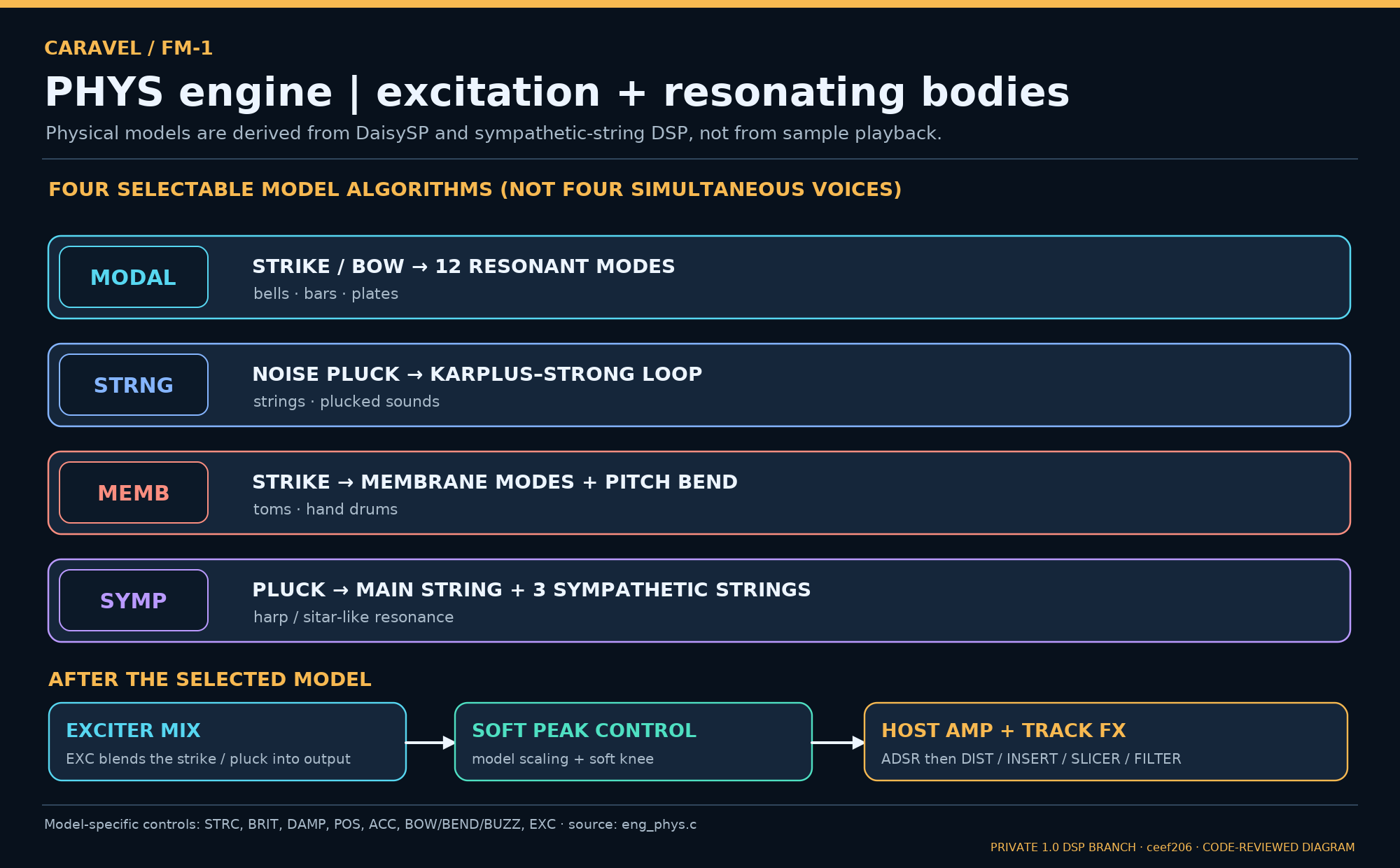
PHYS in Caravel 1.0
Caravel 1.0.0 candidate · BUILD / PLAY controls.
In 60 seconds In BUILD, hold EDIT, choose PHYS / MARIMBA or PLUCK, and play short notes. In PLAY / SOUND, K1–K4 adjust STRC, BRIT, DAMP and POS.
1. Start with one physical model
PHYS models the behavior of resonating objects rather than stacking ordinary subtractive oscillators. Hold HOME for BUILD, then hold EDIT to select PHYS and a starting preset: MARIMBA for a struck tone or PLUCK for a string. In PLAY, EDIT selects SOUND and exposes STRC, BRIT, DAMP and POS on K1–K4. BUILD / EDIT exposes MODEL and the remaining excitation controls.
2. Compare the four MODEL choices
PHYS chooses one model per voice; these are not four layers sounding simultaneously.
| MODEL | What it does | First experiment |
|---|---|---|
| MODAL | A bank of resonators for bells, bars and struck metal | Choose MARIMBA; move STRC to change the relationship of the partials |
| STRNG | A plucked, feedback-based string | Choose PLUCK; try BRIT and DAMP before adding FX |
| MEMB | A struck membrane with a drumhead-like spectrum | Start from HAND DRUM; compare HARM and BEND |
| SYMP | A plucked string exciting three sympathetic strings | Choose HARP; compare CHRD and SYMP amount |
The MEMB model is part of PHYS. It does not imply that the removed standalone DRUM engine is included in the 1.0 profile.
3. Learn the common controls
STRC changes physical structure or overtone spacing; BRIT affects attack and high-frequency energy; DAMP sets the model's natural ringing time; POS changes where the object is excited. ACC responds to velocity, and EXC mixes the excitation itself into the output. In MODAL and STRNG, BOW can sustain resonances with repeated excitation.
These parameters interact. For example, a long DAMP does not guarantee a long audible note if the track's ADSR release is short. Start without reverb, change one parameter, then use ENV / SHAPE to fit the note into the arrangement.
4. Use the model-specific controls
In MEMB, the control normally named STRC is shown as HARM and changes the membrane's harmonic character; BEND adds a falling pitch after a strike. In SYMP, CHRD selects the intervals of the sympathetic strings (including ROOT-based tuning), SYMP controls how strongly they ring, and BUZZ changes the main string's bridge-like character.
For a dark ambient texture, try HARP or DRONE STRING with moderate DAMP, low track level and a restrained reverb send. For a rhythmic sound without a drum engine, start with MARIMBA or HAND DRUM and sequence sparse notes.
5. Understand voices and storage
The engine currently uses up to three PHYS voices per track. Dense held notes or simultaneous layers can compete for those voices. ARP, CHORD EXT and CAPTURE act on note input through the shared track system, not as separate physical-model voices.
SAVE opens PROJECT for durable sound and performance settings. A live CAPTURE loop is not saved in the project or a FORMAT-2 backup.
PHYS model illustration (source-reviewed teaching diagram) · Six-engine overview · ANALOG · Sequencer and ARP